
Introduction
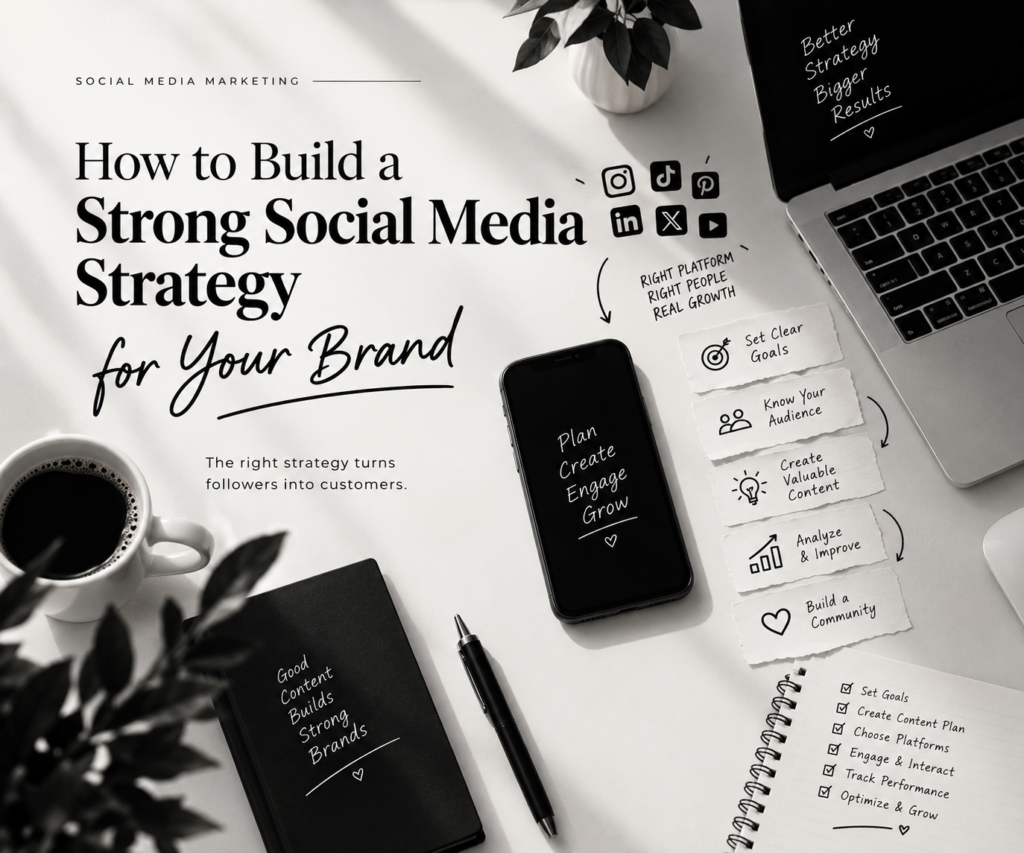
Social media has become an important part of how brands communicate with their audiences. But simply creating an Instagram account, posting regularly, or gaining followers does not automatically create a successful social media presence.
A strong Social Media Strategy starts with understanding who you want to reach, what you want to achieve, what content your audience needs, and how you will measure your results.
Whether you are building a small business, launching a personal brand, or managing an established company, a clear Social Media Strategy can help you create consistent content, strengthen brand awareness, engage with your audience, and support wider business goals.
So, how do you build a strong social media strategy for your brand? The answer begins with planning before posting.
Quick Answer: How Do You Build a Strong Social Media Strategy?
To build a strong Social Media Strategy, define your goals, understand your target audience, choose the right platforms, create relevant content, develop a consistent posting plan, engage with your audience, track performance, and improve your strategy based on data. The goal is not simply to post more, but to create content that supports your brand and provides value to the right audience.
What Is a Social Media Strategy?
A Social Media Strategy is a structured plan that explains how a brand will use social media platforms to achieve specific marketing and business objectives.
It typically covers:
- Marketing goals
- Target audience
- Social media platforms
- Content themes
- Content formats
- Posting schedule
- Engagement approach
- Paid advertising
- Performance measurement
- Strategy improvement
For example, a skincare brand may use Instagram to showcase products and educational Reels, Facebook to communicate with its community, and paid social advertising to reach relevant potential customers.
The exact strategy depends on the business. There is no single Social Media Strategy that works for every brand.
Why Does Your Brand Need a Social Media Strategy?
Posting without a plan can make social media feel inconsistent and difficult to manage. A Social Media Strategy gives your content a clear direction.
Build Brand Awareness
Consistent and relevant content helps audiences become familiar with your brand, its products, services, and values.
Reach Relevant Audiences
Social media platforms provide businesses with opportunities to reach audiences based on factors such as interests, behaviours, demographics, and interactions.
Strengthen Customer Relationships
Social media is also a communication channel. Comments, messages, reviews, polls, and other interactions can help brands communicate with customers and understand their needs.
Support Business Goals
Social media can support objectives such as:
- Website traffic
- Lead generation
- Product discovery
- Customer engagement
- Brand awareness
- Sales and conversions
Understand What Your Audience Responds To
Social media analytics can help marketers understand which content receives attention and engagement. These insights can then be used to improve future content and strengthen the overall Social Media Strategy.
How to Build a Strong Social Media Strategy Step by Step
1. Define Your Social Media Goals
Before creating content, decide what you want social media to achieve.
Your goal could be:
- Increasing brand awareness
- Growing website traffic
- Generating leads
- Increasing engagement
- Promoting products or services
- Building a community
- Supporting sales
A clear goal helps you decide what type of content to create and which metrics to monitor.
For example, if your primary goal is brand awareness, reach and impressions may be useful indicators. If your goal is lead generation, you may focus more on enquiries, form submissions, or other meaningful actions. These goals should guide your Social Media Strategy from the beginning.
2. Understand Your Target Audience
A strong Social Media Strategy begins with the audience.
Instead of asking only, “What should I post?”, ask:
“What does my audience want to know, solve, or discover?”
Research:
- Age and location where relevant
- Interests
- Needs and challenges
- Buying behaviour
- Preferred content formats
- Questions they frequently ask
- Platforms they actively use
You can use customer conversations, comments, reviews, website data, social insights, and competitor research to understand your audience better.
The more clearly you understand your audience, the easier it becomes to create relevant content.
3. Choose the Right Social Media Platforms
You do not need to be active on every platform.
Choose platforms based on your audience, business type, content format, and goals. Your Social Media Strategy should focus on the platforms where your target audience is most relevant.
| Platform | Useful For |
|---|---|
| Visual branding, Reels, product discovery, community engagement | |
| Communities, local businesses, broader audience communication | |
| Professional branding, B2B marketing, industry content | |
| YouTube | Long-form video, tutorials, educational content |
| Visual discovery, inspiration, website traffic | |
| X | Conversations, updates, industry discussions |
These are general use cases, not strict rules. A platform is valuable when it matches the audience and objective of your business.
4. Create Clear Content Pillars
Content pillars are the main topics or themes your brand consistently talks about.
Instead of creating random posts every day, define several content categories.
For example, a digital marketing brand could use:
Educational Content
- SEO tips
- Social media tips
- Marketing guides
Engagement Content
- Questions
- Polls
- Opinions
- Interactive posts
Brand Content
- About the brand
- Values
- Behind-the-scenes content
Promotional Content
- Services
- Products
- Offers
- New launches
Trust-Building Content
- Testimonials
- Case studies
- Results
- Client feedback
Content pillars make planning easier and help create a more balanced social media presence. They also give your Social Media Strategy a clear content direction.
5. Choose the Right Content Formats
Different audiences respond to different formats.
Depending on your platform and objective, you can create:
- Reels
- Short videos
- Carousels
- Static images
- Stories
- Educational posts
- Infographics
- Live sessions
- Blog promotions
For example, a complex topic can be explained through a carousel, while a quick tip may work well as a short video.
The key is to select the format that communicates the message effectively and supports your Social Media Strategy.
6. Create a Content Calendar
A content calendar helps you plan what to publish and when.
A simple calendar can include:
| Date | Content Pillar | Format | Topic | CTA |
|---|---|---|---|---|
| Monday | Educational | Carousel | SEO Tip | Save this post |
| Wednesday | Engagement | Story | Audience Question | Reply |
| Friday | Brand | Reel | Behind the Scenes | Follow for more |
A calendar also helps prevent last-minute posting and makes it easier to maintain consistency.
However, consistency does not mean posting the same content repeatedly. It means maintaining a reliable and purposeful presence.
7. Write Captions That Have a Purpose
A good caption should support the content rather than simply describe it.
A simple caption structure is:
Hook → Value → Context → Call to Action
For example:
Hook: Struggling to create consistent social media content?
Value: A content calendar can help you plan your topics, formats, and publishing schedule in advance.
CTA: Save this post for your next content planning session.
Your CTA should match the purpose of the post. You might ask people to save, comment, share, visit your website, send a message, or learn more.
8. Maintain a Consistent Brand Identity
Your social media presence should feel connected to your overall brand.
Maintain consistency in areas such as:
- Visual style
- Typography
- Brand colours
- Photography style
- Tone of voice
- Messaging
Consistency can make your content more recognizable and create a more professional brand experience. A consistent identity also strengthens the overall Social Media Strategy.
9. Engage With Your Audience
Social media should not be treated as a one-way publishing platform.
Respond to:
- Comments
- Questions
- Direct messages
- Mentions
- Reviews
- Relevant conversations
You can also encourage interaction through questions, polls, quizzes, and discussion-based content.
Meaningful engagement can help brands understand their audience while building stronger online relationships.
10. Use Social Media Analytics
Creating content is only one part of social media marketing. You also need to understand what happens after you publish.
Depending on the platform and objective, useful metrics may include:
- Reach
- Impressions
- Engagement
- Video views
- Saves
- Shares
- Profile visits
- Website clicks
- Leads
- Conversions
Do not focus only on follower count.
For example, a post with fewer likes but several meaningful enquiries may be more valuable to a service-based business than a post with high engagement but no business action.
The right metrics depend on the goal. Tracking these results helps you understand whether your Social Media Strategy is working and where improvements may be needed.
Social Media Strategy Tools for Beginners
The right tools can make planning, creation, publishing, and measurement easier.
Tool/Platform | Purpose | Beginner Use |
Meta Business Suite | Manage Facebook and Instagram | Scheduling and insights |
Canva | Visual content creation | Posts, carousels, graphics |
Google Analytics | Website measurement | Tracking website activity |
Google Search Console | Search performance | Understanding search visibility |
CapCut | Video editing | Short-form video creation |
Professional marketing | B2B content and networking |
Tools should support your strategy rather than become the strategy itself.
Common Social Media Marketing Mistakes to Avoid
Posting Without a Goal
If every post has a different purpose without an overall direction, your content can become inconsistent.
Solution: Connect content with clear marketing objectives.
Trying to Be Active Everywhere
Managing too many platforms can reduce content quality and consistency.
Solution: Start with the platforms most relevant to your audience.
Focusing Only on Followers
Follower growth can be useful, but it does not tell the complete story.
Solution: Track metrics that connect with your actual goals.
Constantly Promoting Products
Audiences may lose interest if every post feels like an advertisement.
Solution: Balance promotional content with educational, engaging, and useful content.
Ignoring Comments and Messages
Posting without responding can make the brand feel disconnected.
Solution: Include community engagement as part of your social media workflow.
Copying Competitors
Competitor research can provide inspiration, but copying their content does not create a unique brand.
Solution: Use research to understand the market, then develop your own voice and ideas.
A Simple Weekly Social Media Workflow
A practical workflow for beginners can look like this:
Monday: Review analytics and audience insights.
Tuesday: Research topics and create content ideas.
Wednesday: Create and edit content.
Thursday: Schedule upcoming posts.
Friday: Engage with the audience and review performance.
Weekend: Collect ideas, monitor relevant trends, and prepare for the next week.
The exact schedule can change depending on the business and available resources. The important part is having a repeatable process.
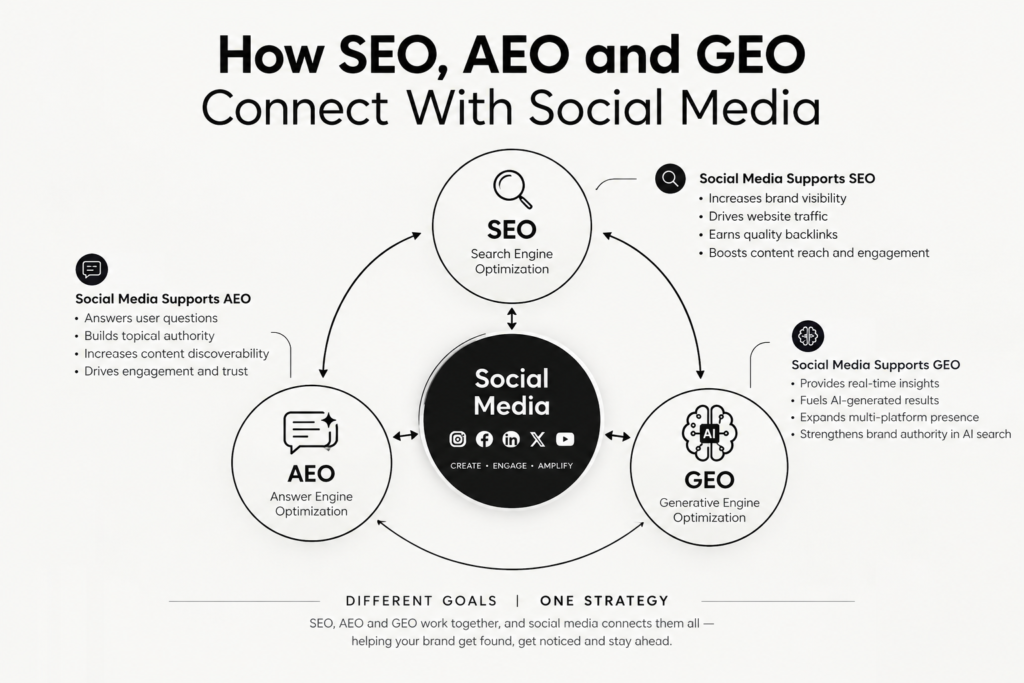
How SEO, AEO and GEO Connect With Social Media
Social media and search are different channels, but they can support one another.
SEO (Search Engine Optimization) focuses on improving a website’s visibility in organic search.
AEO (Answer Engine Optimization) commonly refers to structuring information so that questions can be answered clearly and directly.
GEO (Generative Engine Optimization) is a newer industry term associated with improving the usefulness and visibility of content in generative search experiences.
Social media can support these broader digital marketing efforts by helping brands distribute useful content, understand audience questions, strengthen brand visibility, and direct interested users toward deeper resources such as websites and blogs.
The practical principle remains the same: create useful, clear, original, audience-focused content.
FAQ
Understanding your target audience and defining clear goals are two of the most important foundations. Once you know who you want to reach and what you want to achieve, you can choose appropriate platforms, content formats, and metrics.
There is no universal posting frequency that works for every brand. A better approach is to create a realistic schedule that your business can maintain consistently while protecting content quality.
The best platform depends on the target audience, business type, content format, and marketing objective. Instead of choosing a platform because it is popular, choose platforms where your relevant audience is active.
Start by identifying your audience’s questions, needs, interests, and problems. Turn those insights into content pillars and create different formats such as videos, carousels, stories, educational posts, and promotional content.
Not necessarily. However, a clear next step can be useful when the goal of the content is to encourage an action. The CTA should match the purpose of the post.
Start with your business goal and select relevant metrics. Depending on the objective, you might track reach, engagement, website clicks, leads, enquiries, or conversions rather than focusing only on follower growth.
Conclusion
A strong social media strategy is not about posting every day simply to remain active. It is about creating a clear connection between your business goals, audience needs, content, platforms, and measurable outcomes.
Start by defining your goals and understanding your audience. Choose the platforms that make sense for your brand, develop useful content pillars, create a manageable content calendar, engage with your community, and use analytics to understand what is working. These steps can help you build a more effective and sustainable social media strategy.
Most importantly, treat social media as an ongoing process. Plan, create, engage, measure, learn, and improve.
With a clear social media strategy and consistent execution, social media can become a valuable part of your brand’s wider digital marketing approach and help you build meaningful connections with your audience.