
Introduction
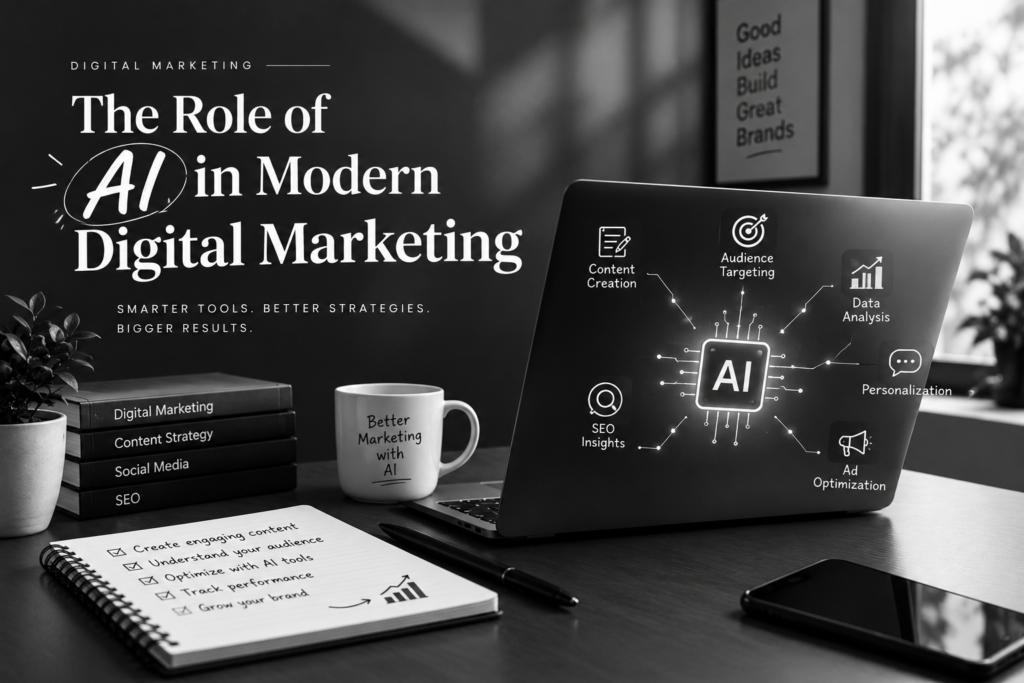
Artificial Intelligence (AI) is changing the way businesses approach digital marketing. From understanding customer behavior to creating content, analyzing campaigns, and automating repetitive tasks, AI has become an important support system for modern marketers.
Digital marketing has always depended on understanding the right audience and delivering the right message at the right time. AI makes this process more efficient by helping marketers work with large amounts of information, identify patterns, and make more informed decisions.
However, AI is not simply about automation. Its real value comes from combining technology with human creativity, marketing knowledge, strategy, and judgment. When used correctly, AI in Digital Marketing can help marketers save time, improve customer experiences, and build more effective marketing campaigns.
AI can accelerate marketing, but human creativity gives it direction.
Quick Answer: What Is the Role of AI in Digital Marketing?
AI in Digital Marketing helps businesses and marketers analyze data, understand customer behavior, personalize experiences, create and optimize content, automate repetitive tasks, and improve marketing decisions.
Instead of replacing the complete marketing process, AI can support different stages of it—from research and content creation to campaign analysis and optimization.
For beginners, the simplest way to understand it is:
AI helps marketers work smarter, while marketing strategy gives AI a clear purpose.
What Is AI in Digital Marketing?
Artificial Intelligence refers to technologies that can perform tasks that normally require human-like capabilities such as analyzing information, recognizing patterns, generating content, understanding language, and making predictions based on available data.
In AI in Digital Marketing, these technologies can be used alongside traditional marketing methods to make different activities more efficient.
For example, a marketer may spend time researching content ideas, analyzing audience behavior, creating social media captions, checking campaign performance, or responding to common customer questions. AI-powered tools can assist with many of these tasks.
This does not mean that marketers no longer need to think strategically. Instead, AI can reduce repetitive work and provide useful support, allowing marketers to spend more time on creativity, planning, communication, and decision-making.
A Simple Example
Imagine a digital marketer wants to create a social media campaign for a new product.
Traditionally, the marketer may need to:
Research the target audience.
Find content ideas.
Create captions.
Prepare different content variations.
Analyze previous campaign results.
Monitor engagement.
Make improvements.
AI tools can assist with several of these activities. The marketer can then review the results, add brand personality, check accuracy, and make the final strategic decisions.
That combination of AI assistance + human expertise is becoming an important part of modern AI in Digital Marketing.
Why Is AI Important in Modern Digital Marketing?
The digital marketing environment is constantly changing. Businesses need to create content, communicate with audiences, analyze performance, and respond to customer expectations across multiple digital channels.
AI can support marketers in several important ways. In AI in Digital Marketing, these capabilities can help marketers manage different marketing activities more efficiently.
1. Faster Marketing Processes
Many marketing activities involve repetitive work. AI can help generate ideas, organize information, summarize data, create initial drafts, and support routine tasks.
This can help marketers use their time more efficiently.
2. Better Audience Understanding
Understanding the target audience is one of the foundations of successful marketing.
AI can help marketers analyze available customer and campaign data to identify patterns and understand what types of content, messages, or experiences may be relevant to different audiences.
3. Personalized Customer Experiences
Customers expect businesses to provide relevant communication rather than the same message to everyone.
AI can support personalization by helping businesses deliver more relevant content, product recommendations, emails, and customer interactions.
4. Content Support
Content creation is a major part of digital marketing. AI can help marketers brainstorm topics, create outlines, develop content variations, and improve drafts.
However, the final content should still reflect the brand’s voice, expertise, originality, and audience needs.
5. Marketing Automation
AI can support automated workflows such as customer communication, content processes, recommendations, and certain repetitive marketing activities.
Automation can reduce manual work and allow marketers to focus on higher-value activities.
6. Data-Driven Decisions
Digital marketing produces large amounts of data. AI can help marketers analyze information and identify patterns that may be difficult to notice manually.
This can support better campaign planning and optimization.
7. Improved Campaign Optimization
AI can assist marketers in understanding campaign performance and identifying areas that may need improvement.
Instead of simply launching a campaign and waiting for results, marketers can continuously analyze performance and make informed adjustments.
How AI Is Changing Digital Marketing
AI is not limited to one area of marketing. It can support multiple parts of the digital marketing process, making AI in Digital Marketing relevant across content, SEO, social media, advertising, personalization, and analytics.
1. AI for Content Creation
Content creation is one of the most visible applications of AI in Digital Marketing.
Marketers can use AI tools to generate:
Blog topic ideas
Content outlines
Social media captions
Email ideas
Headlines
Ad copy variations
Content repurposing ideas
Frequently asked questions
Content calendars
For example, a marketer creating a blog about social media marketing can use AI to brainstorm possible subtopics and organize the article structure.
But generating content is only the beginning.
A marketer should review the output, verify important information, improve the writing, add original insights, and make sure the content matches the brand’s tone.
The key idea:
Use AI to support content creation—not to remove the human element from content.
Originality, experience, storytelling, creativity, and brand understanding still matter.
2. AI for SEO
Search Engine Optimization is another area where AI can support digital marketers. AI in Digital Marketing can make SEO research, planning, and optimization more efficient when used with human judgment.
AI-powered tools can assist with:
Keyword research
Search intent analysis
Topic research
Content planning
Content optimization
Competitor analysis
Content structure
Identifying related topics
For example, instead of choosing a keyword simply because it has search volume, a marketer can use AI-assisted research to understand what users are actually looking for.
This helps the marketer create content that answers real questions rather than simply inserting keywords into an article.
AI can therefore become part of an SEO workflow such as:
Research → Understand Intent → Create → Optimize → Publish → Measure → Improve
The marketer remains responsible for deciding whether the content is genuinely useful and relevant.
3. AI for Social Media Marketing
Social media marketers have to continuously create, publish, monitor, and analyze content.
AI in Digital Marketing can support several parts of this process.
It can help marketers generate:
Social media content ideas
Caption variations
Content themes
Reel concepts
Hashtag ideas
Content calendar suggestions
Audience insights
Performance analysis
AI can also help identify patterns in social media performance.
For example, a marketer can examine which content formats receive stronger engagement and use those insights when planning future content.
However, social media is not only about publishing content.
Human interaction remains important. Responding to audiences, understanding emotions, building relationships, and creating authentic communication require human judgment.
4. AI for Paid Advertising
Paid advertising platforms increasingly use automation and machine learning to help marketers manage campaigns.
AI in Digital Marketing can support areas such as:
Audience targeting
Ad variations
Campaign optimization
Budget-related decisions
Performance analysis
Creative testing
Identifying patterns in campaign data
For example, a marketer may create multiple versions of an advertisement with different headlines or messages. AI-powered systems can help analyze how those variations perform.
But marketers still need to define the campaign objective, understand the target audience, create appropriate messaging, monitor results, and make strategic decisions.
AI can support the campaign.
The marketer controls the strategy.
5. AI for Personalization
Not every customer has the same needs.
Personalization allows businesses to provide more relevant experiences based on available customer information and behavior.
AI in Digital Marketing can support personalization in areas such as:
Email recommendations
Product recommendations
Website experiences
Content suggestions
Customer communication
Advertising experiences
For example, an online store may use customer behavior to recommend products that are relevant to a visitor.
The goal is not simply to show more content. The goal is to make the customer’s experience more relevant and useful.
6. AI Chatbots and Customer Support
AI-powered chatbots can help businesses respond to common customer questions quickly.
For example, a chatbot may assist customers with questions about:
Business hours
Products or services
Basic pricing information
Order-related questions
Frequently asked questions
General service information
This can provide faster responses, particularly when customers need simple information.
However, not every customer question can be handled effectively by automation.
Complex issues, sensitive situations, complaints, or situations requiring judgment may still need human support.
Therefore, a good customer-service system can combine AI assistance with human support.
7. AI for Marketing Analytics
Data is one of the most valuable parts of digital marketing.
Marketers can collect information from websites, social media platforms, advertising campaigns, email marketing, and other channels.
AI can help identify patterns within this information. This is another important application of AI in Digital Marketing because it can help marketers turn large amounts of data into useful insights.
For example, marketers may use AI-assisted analysis to understand:
Which content performs well
Which audiences interact with campaigns
Which channels generate engagement
Where customers drop off
Which campaigns need improvement
What patterns appear in campaign performance
This can help marketers move from simply collecting data to actually using it for decision-making.
Benefits of AI in Digital Marketing
Benefit | How It Helps |
|---|---|
Automation | Reduces repetitive marketing tasks |
Personalization | Creates more relevant customer experiences |
Efficiency | Helps marketers complete tasks faster |
Data Analysis | Makes large amounts of information easier to understand |
Content Support | Helps generate ideas, outlines, and drafts |
Optimization | Supports campaign improvement |
Customer Experience | Enables faster and more relevant interactions |
The biggest benefit is not simply doing more work.
It is about using technology to help marketers work more efficiently and make better-informed decisions through AI in Digital Marketing.
How to Use AI in Digital Marketing: A Simple Process
For beginners, AI can seem complicated. A simple workflow can make AI in Digital Marketing easier to understand.
IDENTIFY → RESEARCH → CREATE → PERSONALIZE → AUTOMATE → ANALYZE → OPTIMIZE
Step 1: Identify
Start by identifying the marketing objective.
Ask:
What do I want to achieve?
Who is my target audience?
What problem am I trying to solve?
Which marketing channel am I using?
AI should not be the starting point. The marketing objective should come first.
Step 2: Research
Use AI tools to support audience research, topic research, competitor analysis, and content brainstorming.
Always review the information before using it.
Step 3: Create
Use AI to support content ideas, outlines, captions, emails, advertisements, or other marketing materials.
Then add your own creativity and expertise.
Step 4: Personalize
Adapt the content to your audience and brand.
Consider your:
Brand voice
Customer needs
Marketing goals
Platform
Audience expectations
Step 5: Automate
Identify repetitive tasks that can be safely automated.
This could include certain workflows, customer responses, reporting processes, or content-related tasks.
Step 6: Analyze
Review the results.
Look at relevant marketing metrics and identify what worked and what needs improvement.
Step 7: Optimize
Use the insights to improve future campaigns.
AI can support this process, but marketers should always evaluate the recommendations in the context of their actual business goals.
Popular AI Tools for Digital Marketers
There are many AI-powered tools available for different marketing activities. Understanding how these tools fit into AI in Digital Marketing can help marketers choose them according to their specific needs.
ChatGPT
Can support marketers with brainstorming, content ideas, outlines, research assistance, copy drafts, FAQs, and content planning.
Canva AI
Can assist with visual design, creative ideas, presentations, social media content, and other design-related tasks.
Google Marketing and Analytics Tools
Google’s marketing ecosystem provides tools that help marketers understand website performance, search visibility, trends, and campaign data.
AI Writing Tools
These tools can assist with drafting, rewriting, summarizing, and improving content.
AI-Powered Advertising Platforms
Advertising platforms use automation and machine learning to support targeting, campaign optimization, and performance management.
AI Analytics Tools
These tools can help marketers understand customer behavior, campaign performance, and patterns within marketing data.
The right tool depends on the marketer’s goal, budget, workflow, and level of experience.
AI and Human Creativity: Why Both Matter
One of the biggest discussions around AI in marketing is whether AI can replace human marketers.
AI can generate content quickly. It can analyze information and automate repetitive activities. But digital marketing requires much more than producing content or analyzing numbers.
Marketing also requires:
Creativity
Strategy
Empathy
Brand understanding
Communication
Critical thinking
Storytelling
Customer understanding
Decision-making
A marketer understands why a campaign should exist, who it is for, and what the brand wants to communicate.
AI can help execute parts of that process, but human judgment remains essential.
AI can accelerate marketing, but human creativity gives it direction.
The most useful approach is therefore not AI versus humans.
It is AI + human expertise.
Common Mistakes When Using AI in Digital Marketing
AI can be powerful, but using it without proper judgment can create problems. Understanding these limitations is an important part of using AI in Digital Marketing effectively.
1. Depending Completely on AI
AI should support your work rather than become your entire marketing strategy.
2. Publishing AI-Generated Content Without Editing
AI-generated content should be reviewed, refined, and adapted before publishing.
3. Ignoring Brand Voice
Every brand has its own personality.
Content should sound like the brand—not like a generic AI-generated message.
4. Using Inaccurate Information
AI-generated information can sometimes be incomplete or incorrect. Important claims should be checked before publication.
5. Creating Repetitive Content
Using similar AI prompts repeatedly can produce content that feels generic.
Add original ideas, examples, experience, and perspective.
6. Focusing Only on Automation
Marketing is not just about saving time.
The final goal is to provide value to the audience and achieve meaningful business objectives.
7. Forgetting the Customer Experience
Technology should make the customer journey better—not simply make the business process faster.
8. Not Reviewing AI Recommendations
AI can provide suggestions, but marketers should evaluate whether those suggestions actually make sense for the campaign and audience.
AI + SEO + AEO + GEO
Modern digital marketing is no longer limited to traditional search engine optimization.
AI is becoming increasingly connected with how people discover and interact with information online. This makes AI in Digital Marketing increasingly relevant to modern search, content, and audience strategies.
SEO — Search Engine Optimization
SEO focuses on making useful content easier for search engines to discover and understand.
AEO — Answer Engine Optimization
AEO focuses on structuring content so that it can directly answer users’ questions clearly and efficiently.
GEO — Generative Engine Optimization
GEO generally refers to optimizing information so it can be more understandable and useful within AI-powered search and generative experiences.
AI in Marketing
AI can support marketers across these areas through:
Research
Content planning
Topic discovery
Search intent analysis
Personalization
Data analysis
Content optimization
Campaign improvement
A modern marketer should therefore understand not only how to use AI tools, but also how search, content, audiences, and marketing strategy work together.
The Future of AI in Digital Marketing
AI is likely to remain an important part of the digital marketing landscape. As AI in Digital Marketing continues to develop, marketers may use these technologies more deeply across different marketing activities.
As AI-powered tools continue to develop, marketers may use them more deeply for content workflows, customer experiences, analytics, automation, advertising, personalization, and strategic planning.
This does not mean that marketers need to become AI engineers.
Instead, digital marketers should develop two complementary skill sets:
Marketing fundamentals + AI-assisted workflows
A strong marketer should understand the basics of:
SEO
Social media marketing
Content marketing
Paid advertising
Email marketing
Analytics
Customer behavior
Brand strategy
Then AI can be introduced as a tool that improves specific parts of that workflow.
The future belongs to marketers who can combine technology, creativity, strategy, and human understanding.
Conclusion
Artificial Intelligence is becoming an important part of modern digital marketing. AI in Digital Marketing can help marketers work faster, understand audiences, analyze information, personalize experiences, create content, automate repetitive tasks, and improve campaigns.
But successful marketing is not simply about using the latest AI tool.
The real value comes from knowing when to use AI, how to use it responsibly, and how to combine it with human creativity and marketing strategy.
AI can provide speed and efficiency. Human marketers provide context, creativity, empathy, and direction.
The future of digital marketing is not AI versus humans—it is smarter marketing powered by AI and guided by human creativity.
Ready to build a smarter digital presence? Let’s connect, collaborate, and grow your brand.