
How to Become a Digital Marketer: A Beginner’s Guide to Starting Your Career

Digital marketing has changed the way businesses connect with customers. From social media posts and search engines to email campaigns, websites, and online advertising, businesses now have many ways to reach people digitally.
This growth has also created opportunities for people who want to build a career in marketing. If you are wondering how to become a digital marketer, you do not need to learn everything at once. You can start with the fundamentals, develop practical skills, work on real projects, and gradually build a professional portfolio.
Whether you are a student, graduate, career starter, or someone looking to move into a new field, digital marketing can offer several paths to explore.
Quick Answer: How Do You Become a Digital Marketer?
To become a digital marketer, start by learning the fundamentals of digital marketing and develop practical skills in areas such as SEO, social media marketing, content marketing, paid advertising, email marketing, analytics, and copywriting.
A simple digital marketing career path looks like this:
Learn → Practice → Specialize → Build a Portfolio → Gain Experience → Apply for Opportunities → Keep Learning
You do not need to master every area before starting. Build a strong foundation first, then develop deeper expertise in the areas that interest you most.
What Is Digital Marketing?
Digital marketing is the promotion of products, services, or brands through digital channels. If you are exploring how to become a digital marketer, understanding these channels and how they work together is an important first step.
These channels include:
- Search engines
- Social media platforms
- Websites and blogs
- Online advertising
- Video platforms
- Digital applications
For example, a new clothing brand might use Instagram to introduce its products, SEO to attract people searching for fashion-related information, email marketing to stay connected with customers, and paid advertising to promote a new collection.
This shows that digital marketing is more than simply creating social media posts. Learning how to become a digital marketer involves understanding an audience, developing effective strategies, creating useful content, choosing suitable channels, measuring results, and improving campaigns based on what the data shows.
Why Choose Digital Marketing as a Career?
One of the biggest advantages of digital marketing is that it combines several different skills. If you are exploring how to become a digital marketer, you can develop skills in creativity, communication, research, technology, strategy, and data analysis.
It also offers different career paths depending on your interests.
For example:
- Enjoy writing? Content marketing or copywriting may suit you.
- Like research and problem-solving? SEO could be a good choice.
- Enjoy social media and creativity? Social media marketing may be interesting.
- Like numbers and testing? Performance marketing or analytics could be a strong fit.
- Enjoy planning campaigns? Digital marketing strategy may be the right direction.
Some common digital marketing roles include:
- Digital Marketing Executive
- Social Media Specialist
- SEO Specialist
- Content Marketer
- PPC Specialist
- Email Marketing Specialist
- Performance Marketer
- Digital Marketing Strategist
As you learn how to become a digital marketer, you can also explore freelance work, agencies, in-house marketing teams, or eventually build your own consulting business. The right path depends on your interests, strengths, and the skills you choose to develop.
Essential Digital Marketing Skills to Learn How to Become a Digital Marketer
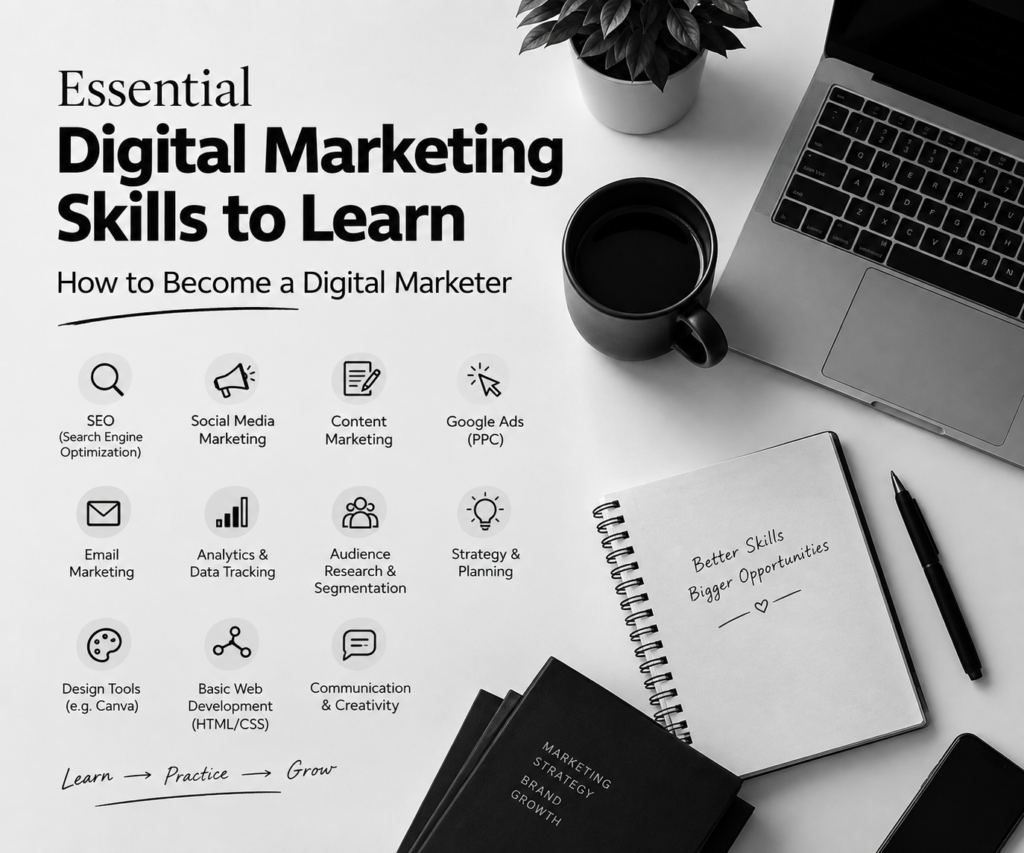
A beginner does not need to become an expert in every area. However, understanding the major areas of digital marketing gives you a strong foundation. If you are learning how to become a digital marketer, developing a basic understanding of these key areas can help you identify your interests and choose the skills you want to focus on.
1. Search Engine Optimization (SEO)
SEO helps websites and content become more discoverable through organic search.
As a beginner, learn:
- Keyword research
- Search intent
- On-page SEO
- Content optimization
- Technical SEO basics
- Website structure
- Basic SEO analytics
Good SEO is not simply about adding keywords to a page. It is about creating useful content that matches what people are searching for.
2. Social Media Marketing
Social media marketing involves using platforms to build awareness, engage audiences, generate leads, and support business goals.
Learn about:
- Content planning
- Audience research
- Content calendars
- Platform-specific strategies
- Captions and copywriting
- Community engagement
- Social media analytics
A strong social media strategy starts with understanding the audience and business objective rather than simply posting every day.
3. Content Marketing
Content marketing focuses on creating valuable and relevant information for a target audience.
Content can include:
- Blog posts
- Social media content
- Videos
- Guides
- Infographics
- Case studies
- Newsletters
The goal is to create content that helps the audience while supporting a broader marketing objective.
4. Paid Advertising
Paid advertising allows businesses to reach specific audiences through advertising platforms.
Beginners should understand:
- Campaign objectives
- Audience targeting
- Ad creatives
- Budgets
- Landing pages
- Conversion tracking
- Campaign performance
- Optimization
Learning how to analyze why an advertisement performs well is just as important as learning how to create the advertisement.
5. Email Marketing
Email marketing allows businesses to communicate directly with subscribers and customers.
Important concepts include:
- Email campaigns
- Newsletters
- Subject lines
- Segmentation
- Personalization
- Automation
- Calls to action
- Performance measurement
6. Analytics
Analytics helps marketers understand what is happening after people interact with their marketing activities.
You should become familiar with concepts such as:
- Website traffic
- Engagement
- Click-through rate
- Conversion rate
- Leads
- Cost per result
- Campaign performance
The purpose of analytics is not simply to collect numbers. It is to understand what happened, why it happened, and what should be improved next.
7. Copywriting and Communication
Digital marketers communicate through words every day.
Copywriting is useful for:
- Advertisements
- Social media captions
- Websites
- Emails
- Headlines
- Landing pages
- Calls to action
Clear and audience-focused communication can make marketing messages more effective. These core skills provide a practical foundation for anyone exploring how to become a digital marketer and building a career in the digital marketing field.
How to Become a Digital Marketer: Step-by-Step
Step 1: Learn the Fundamentals
Start by understanding the basics before moving into advanced strategies.
If you are learning how to become a digital marketer, begin by understanding how SEO, social media marketing, content marketing, email marketing, paid advertising, analytics, and conversion optimization work together.
Understanding the purpose of each channel will help you make better marketing decisions later.
Step 2: Choose an Area of Interest
Digital marketing is broad, so choose one or two areas to explore more deeply.
You do not have to make a permanent decision. Your specialization can change as you gain experience.
For example, you might start with social media marketing and later develop skills in SEO, paid advertising, or content strategy.
Step 3: Learn the Right Digital Marketing Tools
Tools help marketers research, create, manage, measure, and optimize campaigns.
Depending on your specialization, you may work with:
- SEO tools
- Analytics platforms
- Social media management tools
- Advertising platforms
- Email marketing software
- Content planning tools
- Graphic design tools
- Website and CMS platforms
Do not focus on learning every tool available. Learn the tools that support the skills you are developing.
More importantly, understand why a tool is being used and what decision it helps you make.
Step 4: Practice With Real Projects
This is one of the most important steps for anyone learning digital marketing and wondering how to become a digital marketer.
You can create a practice project such as:
- A sample business
- A social media page
- An SEO blog
- A content calendar
- A sample advertising campaign
- A brand audit
- A digital marketing strategy
For example, you could choose a fictional skincare brand and create its target audience profile, content strategy, Instagram plan, SEO topics, and sample advertising campaign.
This allows you to turn theory into practical experience.
Step 5: Build a Digital Marketing Portfolio
A portfolio shows employers and clients what you can actually do.
Your portfolio can include:
- Social media campaigns
- SEO projects
- Blog articles
- Content calendars
- Marketing strategies
- Brand audits
- Advertising concepts
- Analytics reports
- Case studies
For each project, explain:
Objective → Audience → Strategy → Execution → Measurement → Learning
This is more valuable than simply displaying a collection of designs because it demonstrates your marketing thinking.
Step 6: Gain Practical Experience
Once you have some projects, look for opportunities to apply your skills.
You can gain experience through:
- Internships
- Freelance projects
- Personal projects
- Volunteer work
- Student projects
- Small businesses
- Entry-level marketing positions
Even a small project can become valuable portfolio material if you document your process and what you learned.
Step 7: Keep Learning and Adapting
Digital marketing is constantly evolving.
Search behaviour changes. Social platforms introduce new features. Advertising systems develop. Consumer expectations change. AI-powered search experiences are also becoming part of the broader search landscape.
That means a good digital marketer should develop a habit of continuous learning rather than depending on one course or certification.
If you want to understand how to become a digital marketer and build a long-term career in the field, focus on developing practical skills, gaining real experience, staying updated with industry changes, and continuously improving your strategies based on data and results.
Digital Marketing Tools Beginners Should Know
You do not need dozens of tools when you are starting.
Marketing Area | Tool Category to Learn |
SEO | Keyword research and SEO tools |
Analytics | Website and campaign analytics |
Social Media | Scheduling and analytics platforms |
Paid Advertising | Search and social advertising platforms |
Email marketing and automation tools | |
Design | Graphic design platforms |
Content | Writing and content planning tools |
Websites | CMS and website-building platforms |
The goal is not to collect tools. The goal is to understand how tools help you execute and measure marketing strategies.
How to Get Your First Digital Marketing Job or Client
Once you have basic skills and a portfolio, start looking for opportunities. Knowing how to become a digital marketer is not only about learning skills but also about applying them through real projects and professional opportunities.
For an entry-level job, prepare:
A focused resume
A professional LinkedIn profile
A digital marketing portfolio
Relevant project examples
A short professional introduction
You can search for roles such as:
Digital Marketing Intern
Digital Marketing Executive
SEO Executive
Social Media Executive
Content Marketing Assistant
PPC Assistant
If you want to freelance, start with a specific service instead of simply saying that you “do digital marketing.”
For example:
“I help small businesses build a consistent social media presence through audience-focused content and strategic planning.”
A specific offer is easier for potential clients to understand. As you continue learning how to become a digital marketer, gaining practical experience through jobs, freelance projects, or personal projects can help you build confidence and develop a stronger professional profile.
Common Mistakes Digital Marketing Beginners Should Avoid
When learning how to become a digital marketer, it is easy to make a few common mistakes. Avoiding these mistakes can help you learn more effectively, build practical skills, and develop a stronger foundation.
Trying to Learn Everything at Once
Digital marketing is a large field. Focus on building a foundation before trying to master every platform.
Focusing Only on Certificates
Courses and certifications can support your learning, but practical projects help demonstrate what you can actually do.
Ignoring Analytics
Followers and likes are not the only measures of success. Learn to connect marketing activities with meaningful objectives and outcomes.
Copying Other Marketers
Studying successful campaigns is useful, but copying someone else’s strategy without understanding the audience or objective is unlikely to produce the same results.
Following Every Trend
Not every trend is suitable for every business. Choose strategies based on the audience, brand, objective, and available resources.
Waiting to Build a Portfolio
You do not have to wait for your first job. Personal and practice projects can become portfolio pieces while you are still learning. Building these projects early is an important part of understanding how to become a digital marketer through practical experience.
Digital Marketing Career Path
There is no single path to becoming a digital marketer.
A possible career progression could look like:
Beginner → Intern/Junior Marketer → Specialist → Senior Specialist → Strategist/Manager → Leadership or Consultancy
You can specialize in:
- SEO
- Social media marketing
- Performance marketing
- Content marketing
- Email marketing
- Marketing analytics
- E-commerce marketing
As you gain experience, you may discover that combining several skills makes you more valuable as a marketer.
How SEO, AEO, and GEO Are Changing Digital Marketing
Search is becoming more conversational and increasingly includes AI-powered experiences. This makes it important for marketers to think beyond traditional keyword targeting. For anyone learning how to become a digital marketer, understanding how search, answer engines, and generative AI experiences are changing can be an important part of developing modern digital marketing skills.
SEO — Search Engine Optimization
SEO focuses on improving a website’s ability to be discovered through organic search.
AEO — Answer Engine Optimization
AEO is commonly used to describe the practice of structuring content around clear questions and direct answers so that information is easier for answer-oriented search experiences to understand.
For example, instead of only targeting:
“digital marketing career”
a useful article might directly answer:
“What skills do I need to become a digital marketer?”
GEO — Generative Engine Optimization
GEO is a newer industry term associated with optimizing content for generative search experiences.
Rather than relying only on keyword repetition, marketers should focus on:
Clear information
Strong topical coverage
Useful context
Original insights
Accurate claims
Logical structure
Trustworthy sources
Google’s current guidance specifically notes that SEO best practices remain relevant to its generative AI search experiences and cautions against creating low-value content primarily to manipulate rankings.
The practical takeaway is simple: create content for people first, then make it easy for search systems and AI systems to understand. This people-first approach is also an important principle to keep in mind when learning how to become a digital marketer and creating content for today’s evolving digital landscape.
FAQ
Learn. Practice. Grow. Repeat — that’s how to become a digital marketer
To learn how to become a digital marketer, start by understanding the fundamentals of SEO, social media marketing, content marketing, email marketing, paid advertising, and analytics. Then practice these skills through real or personal projects and build a portfolio.
Important skills include SEO, social media marketing, content creation, copywriting, paid advertising, analytics, communication, and strategic thinking. You do not need to master everything at once. Start with the basics and gradually develop your expertise.
A specific degree is not always required to become a digital marketer. Practical skills, relevant knowledge, hands-on experience, and a strong portfolio can help demonstrate your abilities to employers and clients.
The time required depends on your learning pace, background, and the areas you want to specialize in. You can learn the fundamentals within a few months, while developing advanced skills requires continuous practice and experience
The tools you learn will depend on your specialization. Beginners can explore SEO tools, analytics platforms, social media management tools, advertising platforms, email marketing software, content creation tools, and website management platforms.
You can gain experience through personal projects, internships, freelance work, volunteer projects, or by helping small businesses. Creating and documenting practical projects is a useful way to build a portfolio while learning how to become a digital marketer.
Conclusion
Becoming a digital marketer is a process of continuous learning, practice, and improvement. If you are wondering how to become a digital marketer, remember that you do not need to know everything before starting.
Begin with the fundamentals, explore different areas of digital marketing, develop practical skills, learn relevant tools, and create projects that demonstrate your abilities.
As you gain experience, build a professional portfolio and start looking for internships, jobs, freelance opportunities, or other ways to apply your skills.
Most importantly, do not focus only on learning more. Focus on applying what you learn.
Learn the fundamentals. Practice with purpose. Build your portfolio. Measure your results. Keep adapting.
That is how you can turn an interest in digital marketing into a meaningful career and take practical steps toward becoming a successful digital marketer.